
Tangent Machining w/Barrel, Semi Circle Cutters

Finishing faster than ever

  • Tangent plane machining

  • Tangent machining

  • Prismatic fillet finishing

Close-up view of a precision instrument tip, possibly a pipette or needle, hovering over a surface with small blue beads or droplets.

Greater Step Down

  • Cusp Height .0005

  • Planer or Complex Face

  • Side Wall Avoidance

Close-up of a precision milling machine cutting into a metal surface with a silver and yellow cutting tool.

Filling and Bounding

  • One Cycle Finish

  • Planer or Complex Face

  • Bounding Edges + Corners

  • Complete Finish

Tested surface quality

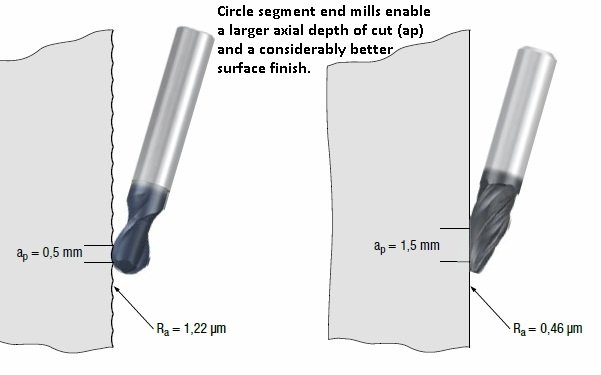
Compared to machining with ball milling cutters, the theoretical scallop height does not change significantly with larger line increments. This was proven in real-life applications using surface testing methods. A reference surface was machined using a ball cutter with a radius of 3 mm and a barrel cutter with a radius of 350 mm. While the quality of both surfaces was nearly the same, the machining time was 90 percent shorter using the barrel cutter.

Comparison of surface textures analyzed by a ball mill and a barrel cutter, showing microscopic images with data on surface roughness parameters.
Series of five different mechanical pencils or pens, each with a different tip design and body shape, arranged from left to right.
Diagram comparing cutting tools with different edge radii, showing that larger radii enable a larger axial depth of cut and better surface finish. The left side shows a tool with an edge radius of 1.22 micrometers and a cutting edge radius of 0.5 millimeters, while the right side shows a tool with an edge radius of 0.46 micrometers and a cutting edge radius of 1.5 millimeters.